
Apr
22
1.0. Introduction
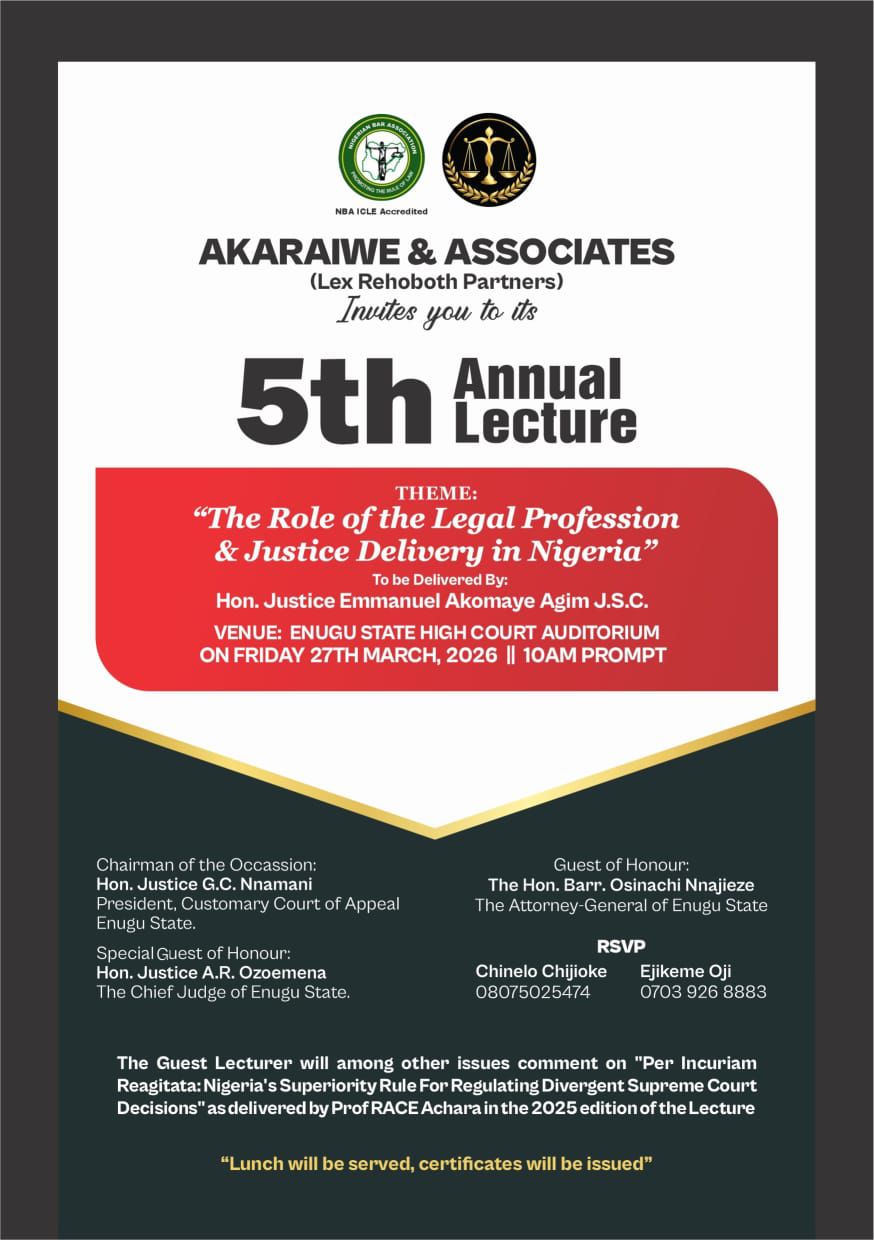
1.1. This Annual lecture is an event organized by the law Firm of Akaraiwe & Associates (Lex Rehoboth Chambers) annually, with its 1st edition held in 2021.
1.2. The 5th edition of the Annual Lecture of Akaraiwe & Associates, took place on the 27th day of March, with the theme: “The Role of the Legal Profession and Justice Delivery in Nigeria”; at Hon. Justice I. A. Umezurike Auditorium, Enugu State High Court Complex, 3—Arm Zone, Independence Layout, Enugu, Enugu State, Nigeria.
2.0. Commencement:
2.1. The event commenced at 10:00a.m. with the arrival and registration of guests; an opening prayer, led by Pastor Christopher Ucheagwu at 10:54 a.m.; and the national anthem rendered at 10:55 a.m. The event was anchored by Ifeoma Adaghara, Esq.
3.0. Attendance And Notable Personalities:
3.1. The Executive Governor of Enugu State, His Excellency, Dr. Peter Ndubuisi Mbah, ably represented by the Hon. Attorney-General and Commissioner for Justice, Enugu State, Hon. Osinachi Nnajieze, was the Chief Host of the event.
3.2. Other notable dignitaries include:
a. The Chief Judge of Enugu State, Hon. Justice Ozoemenam
b. The Guest Lecturer, Hon. Justice Dr. Emmanuel Akomaye Agim, JSC
c. The Chairman of the occasion, the President of the Customary Court of Appeal, Hon. Justice George Chibueze Nnamani, FCIArb., FANA
d. The convener, Ikeazor Akaraiwe, SAN
e. Hon. Justice Oluedo
f. Hon. Justice Ogbuabor
g. Hon. Justice E. N. Nnamani
h. Hon. Justice A. A. Nwobodo
i. Hon. Justice Matthew Eluke
j. Hon. Justice C. C. Ani, (Ph.D) MCIArb.
k. Hon. Justice Alukwu
l. The Chairman of the Magistrates of Nigeria, Your Worship, C. K. C. Udu
m. All other Magistrates present
n. The President of the Nigerian Bar Association, Mazi Afam Osigwe SAN
o. The Chairman of the NBA Branches in Enugu State, Chief V. C. Odoh, Esq.
p. Director of the Multi-Door Court House, Enugu, Mrs. Carolyn Etuk
q. The Leader of the Bar, Dr. E. E. J. Okereke
r. Chief Iyom Edith Offia, SAN
s. Anthony I. Ani, SAN - Discussant
t. Chief Emeka Obegolu, SAN
u. Chief Augustine Alege SAN
v. Chairman of the Annual General Planning Committee (AGPC) of the 2026 Annual General Conference of the NBA, Abdul Mohammed SAN
w. Alternate Chairman, AGPC 2026, Sani Somir, SAN
x. Musa Adam SAN
y. Secretary of the AGPC, 2026, Barbara Amosu
z. Welfare Secretary of the Nigerian Bar Association, Autah Nyada
aa. Former Chairman, Abuja Bar, Chief Afam Okeke
bb. Ikechukwu Onuoma, SAN
cc. Mbadugha SAN
dd. Gozie Obi, SAN (from Anambra) - Discussant
ee. Johnny Agim SAN (from Calabar) - Discussant
ff. Mrs. Oyinkansola Badejo-OKusanya, SAN
gg. Mr. Peter Eze
hh. Chief Akpota, SAN
ii. The Dean of the Law Faculty, University of Nigeria Enugu Campus, Prof. Festus O. Ugwueze, ably represented by Dr. Colins Ajigbo
jj. The Dean of the Law Faculty, Enugu State University of Science and Technology, Prof. Osita Ogbu
kk. Rapulu Nduka, Esq.
ll. Elder Statesmen of the Bar
mm. Other distinguished members of the Bar
nn. Students of Enugu State University of Technology (ESUT)
3.3. Dignitaries who joined via the Zoom link to this event include:
i. The retired Chief Judge of Enugu State, Hon. Justice Emeghelu
ii. Chief Emeka Ngige, SAN
iii. Rotimi Jacob, SAN
4.0. Welcome Address By The Chairman Of The Occasion, The President Of The Customary Court Of Appeal, Enugu State, Hon. Justice George Chibueze Nnamani, FCIArb., FANA
4.1. The Chairman, in his opening remarks thanked God for the host and convener of this annual lecture, Mr. Ikeazor Akaraiwe, SAN for bridging and sustaining his undisputed position as the undisputed heavy weight champion of continued legal education in the South East.
4.2. He also prayed God Almighty to continue to renew, fertilize his mind with great ideas; and deepen his pocket with the economic requirements to sustain this great initiative from year to year.
4.3. He stated that this year’s edition of the annual lecture is spectacular, not just because of the choice of topic, but because it has attracted the “Eagle on The Iroko”, Hon. Justice Agim, JSC.
4.4. He noted that it is a great delight to have the guest lecture physically present as so many guests present may have only seen Justice Agim, JSC, only on the pages of newspapers, magazines, television and through the law reports.
4.5. The Chairman praised the quality of every of Justice Agim JSC’s judgments as being an encyclopedia of erudition, literary finesse, justice, and bravery.
4.6. He cited the Igbo proverb which says that: “If you climb the iroko tree, get as much fire wood as you can because it is a feat you do not accomplish twice in a lifetime.” The Chairman then added that his harvest of the wisdom from Justice Agim, JSC would be with a giant basket.
4.7. He summarized by saying that: “The taste of the pudding is in the eating.” He also made reference to the Nsukka man’s local green leaf parcel popularly known as “Ngwugwu”(‘i.e. wrapped meat’); and said that since the meat is wrapped in a way that you can freely eat from it, you do not need to burrow a hole into it and eat from it. He declined making further introductory remarks but enjoined all participants to stay engaged on the lecture and drink from the fountain of wisdom that will flow there from.
5.0. Citation Of The Guest Lecturer, Hon. Justice (Dr.) Emmanuel Akomaye Agim JSC, As Presented By Ikeazor Akaraiwe SAN (Instead Of Mr. Rapulu Nduka, Esq.)
5.1. Ikeazor Akaraiwe SAN recognized the Honourable Justices, the Chairman of the Occasion, the Guest Lecturer, the Magistrates, the President of the Nigerian Bar Association and his entourage, the distinguished Senior Advocates of Nigeria, and members of the Bar present; and read out the citation of Hon. Justice Dr. Emmanuel Akomaye Agim JSC as follows:
5.2. Notable Judicial Offices held:
- Justice of the Supreme Court of Nigeria
- Commander of the Federal Republic of Nigeria
- Order of the Republic of the Gambia
- He is a man of so many parts.
- Once a Justice of the Supreme Court of the Kingdom of Swaziland at the Southern tip of Africa
- Chief Justice of the Gambia: Akaraiwe SAN hinted that this was the first time he heard of Justice Agim, when he (Akaraiwe) had visited the Gambia for the African Commission for Human and People’s Rights.
- Once a member of the ECOWAS Chief Justices
- Once a member of the Committee in charge of preparing the processes for the formation of the West African Judges’ Forum
- One time Justice of the Supreme Court of the Gambia
- Once the President of the Court of Appeal of the Gambia
- Formerly a Justice of the Court of Appeal of the Gambia, before his elevation as President of the Court of Appeal of the Gambia
- Chairman-General, Legal Council of the Gambia
- Chairman of the Capacity Building for the Judiciary of the Gambia
- Director, Judicial Training of the Gambia
- Chairman of the Gambia National Law Reporting Council
- Once a DPP in the Republic of the Gambia
- Was a lecturer in the University of the Gambia and Lecturer at the Gambia Law School
- One of the contentious and most experienced Justices in Nigeria today
5.3. Ikeazor Akaraiwe SAN referenced the description made of the judgments of Hon. Justice Agim JSC, by the Chairman of the occasion, Hon. Justice G. C. Nnamani, and stated that an excursion into the judgments of Justice Agim is an excursion into high intellectualism.
5.4. Academic Qualifications:
- LLB (Hons.) from the University of Calabar
- BL from the Nigerian Law School, Lagos
- LLM on International Trade Law from the University of Bulvampool, UK
5.5. Honours and Awards
- Commander of the Federal Republic of Nigeria (CFR)
- Order of the Republic of the Gambia (ORG)
- Appointed a Professor of Law in the West Africa insurance Institute owned by the five (5) English-speaking West African nations
- LLD from the University of Calabar, Nigeria
5.6. Major publications
Include (but not limited to):
- The Gambian Legal System (which is, today, the authoritative text at the Gambian University and the Gambian Law School)
- The Pre-Trial Processes in the Commonwealth States: The Gambia….
- The Commonwealth Guidelines for Treatment of Crime Victim (Justice Agim JSC as co-author of that book)
5.7. Landmark Contributions to the development of Law and Society; Include (but not limited to):
- Restatement of the Law and the proper application of Section 17 of the Advance Fee Fraud Act to enable a lawful fair and transparent process of non-conviction forfeiture components: Mellows v. EFCC.
- Expanded the frontier of the scope of the law on the duty of care in cases of negligence by electricity providers in the case of NEPA v. Owalu.
- Treated the scope of the right to privacy to include right to vote in private. See the famous case of Nwali v. EBSIEC.
- Made a pathway on the computation and application of the 2022 Electoral Act to provide for free and transparent elections. See Oyetola v. Adeleke.
- Laid the pathway concerning how to awfully change national currency in the famous case of Attorney-General of Kaduna v. Attorney-General of the Federation (2023).
- Solved the decades-old frustration of Local Governments by State Governments. See the case of Attorney-General of the Federation v. Attorney-General of Abia State
- Set the legal limits for Police patrol to preventing crime. See the case of Enyinnaya v. State.
- Stated the undesirability of payment of severance to pension benefits to holders of public office in one of his Supreme Court judgments.
- Stated the illegality of the Governors’ Forum and the ALGON exercising its powers on the Local Government Area. See Reokes Case.
- Declared the sovereignty of Nigeria as belonging to the people of Nigeria. See the case of Attorney-General of Kaduna & Others v. Attorney-General of the Federation.
5.8. Work Experience:
- Private legal practice
- Director of Public Prosecution (DPP) in the Ministry of Justice
- Judicial Administration
- Judicial training
- Law teacher
- Writer
- Law reporter
- Expert in legal systems
6.0. The Keynote Lecture: The Role Of The Legal Profession And Justice In Nigeria By Hon. Justice Dr. Emmanuel Akomaye Agim, JSC
6.1. Introduction
6.1.1. Hon. Justice Emmanuel Akomaye-Agim, JSC opened by specially acknowledging the presence of:
- Mazi Afam Osigwe, SAN
- Chief Augustine Alegeh, SAN
- Chief Justina Offia, SAN
- Mrs. Ifeoma Adaghara
- Anthony Ani, SAN
- Ikechukwu Onuoma, SAN
- Ikeazor Akaraiwe, SAN (for putting this lecture together)
- All distinguished participants, who made out time to be here
6.1.2. He pondered on the essence of continuing discussions on this subject, amid the many talks that have already been made for many years on it without much corresponding action. He then recommitted to continue, without giving up, until the desired change comes.
6.1.3. He further noted that frequent discussions on this theme makes the courts and lawyers:
1. To remain conscious of the role imposed on them by law in the functioning of the legal system.
2. To measure their performance so far as they impact on the wellbeing of the society.
3. Since the society is dynamic and its legal system should evolve with it, to be relevant, useful and effective.
4. To continuously examine their role performance in helping the legal system evolve to meet the demands of changed circumstances.
5. To help offer the public to better understand how the courts and lawyers operate to contribute to effective and efficient application of law and justice delivery
6. To enable society know the relevant parameters to objectively evaluate the role and performance of lawyers and the courts.
7. To promote public confidence in the legal system.
6.1.4. He then put up a poser: “Do we really understand that as judicial officers and legal practitioners, we are the midwives of our legal system and the custodians of the rule of law?”
6.1.5. Lawyers are primarily responsible for driving the legal system and ensuring the complete rule of law through our advices, actions, presentations, submissions, and decisions in each case, the courts or any dispute resolution process. Each case is not just about resolving the disputes between parties, but, it is more importantly, about meeting the requirements and objectives of the law and the objectives and the interests of the society.
6.1.6. We must always, at all times, carefully consider and measure if each of our advices, actions, presentations, submissions, and decisions meet these requirements and objectives; and strengthen or weaken the workings of the legal system.
6.1.7. Based on his experience from the practice of some lawyers in court today, and as a result of the accusations and blames laid upon the courts by the public, as the cause of the challenges facing our legal system (while the lawyers are at the forefront); he asked: “Do we really understand the nature and scope of our legal system”?
6.2. The Nature and Purpose of Law
6.2.1. The legal system of a State constitutes of the laws, the institutions that make and administer the laws and the methods of administration of the laws.
6.2.2. In Nigeria, the law constitutes of the Constitution of the Federal Republic of Nigeria, Acts of the National Assembly, the Laws of State Houses of Assembly, Customary laws and the Islamic laws.
6.2.3. The laws reflect the fundamental values of the society, the aspirations and yearnings of the people; and constitute an edifice of principles, values and statements which a society is committed to.
6.2.4. Its objective is to provide answers to the fundamental human needs.
6.2.5. He cited Baroness Helena Kennedy QC, Director of the International Bar Association Human Rights Institute, who described law as:
The bedrock of a nation- it tells who we are, and what we value, and that almost nothing else has more impact on our lives. The law is entangled with everyday existence, regulates our social relations and business dealings; controlling conducts which could threaten our safety and security, establishing the rules by which we live. It is the baseline. Law is created by God to help man enjoy his status as God’s best creation. Law preserves order, peace and security of lives and property. It makes the society secure and stable; regulates relationships; regulates the behavior of citizens; safeguards expectations; functions as a means of governance. It is a device for the distribution of resources and burdens. It is a mechanism for conflict resolution. Through the discharge of these functions, the law has today assumed the dynamic role of transformation and development of societies. It has, therefore, become an instrument of social, political and economic change. Government relies on the use of law for promoting development. Whatever plans of change or development are contemplated has to be produced through legislation. We live under the rule of law.
6.2.6. However, the law cannot rule or perform these functions unless it is made, administered or enforced by institutions established to make administer or enforce it.
6.2.7. These institutions are primarily the legislature that makes the law; the judicature that applies the law and determines the lawfulness of all actions; the executive that execute the law; legal practitioners that have the exclusive responsibility to act as legal advisers, to represent persons who seek justice through law and to guide the courts in the application of specific laws to resolve disputes.
6.2.8. Some other institutions in the administration of law include: quasi official bodies like professional practice regulatory bodies that statutes have given exclusive responsibility to regulate practice and service patterns in certain spheres of human life such as engineering, banking architecture, etc.
6.2.9. The role of courts and legal practitioners in the administration of law is a more fundamental and central determinant of the effectiveness of the law in the realization its objectives and in performing its important role in society and the functioning of the rule of law.
6.2.10. Most of the judicial officers that constitute and manage the courts in Nigeria are basically legal practitioners on the bench; except for a few judicial officers in some Customary courts, Khadi courts, local/native courts and some Area courts that are not legal practitioners.
6.2.11. Other legal practitioners, either in private practice, corporate bodies, academics, in-house practice and in other organizations, etc., that are not on the bench are at the Bar.
6.2.12. The law being the centerpiece of the structure of the State; the strength of the legal system will depend on how effective the rule of law is. The less effective law is, the weaker the legal system.
6.2.13. Contemporary experience has shown that a weak or collapsed legal system can result in the failure of the entire State structure. The strong and optimally functioning legal system is therefore necessary for the existence of good governance and a viable State structure.
6.2.14. Since the role of the legal profession in the administration of the rule of law is a more fundamental determinant of the effectiveness of law in realizing its objectives and performing its important role in the society, the effectiveness of law depends on how the courts and lawyers perform their roles in the administration of law.
6.2.15. Therefore, it follows that the strength or weakness of the legal system and the welfare of the society as a whole depends on how the courts and the legal practitioners discharge their roles in the administration of law. Their roles in the courts and other dispute resolution mechanisms are merged. But the public perception is that the courts and other established dispute resolution processes are not functioning properly in effective and efficient application of law and justice.
6.3. Challenges in the Nigerian Legal System
6.3.1. The learned Justice catalogued the following generally expressed concerns about the functioning of the legal system:
• Delayed trial processes and denial of hearings within a reasonable time
• Frustrating access to courts and justice
• Allegations of corruption and lack of judicial independence
• Conflicting decisions of courts, particularly at the Supreme Court level
• Uncertainty of binding precedence
• Abuse of court process by multiplicity of suits over the same events that often result in contradicting orders of courts of co-ordinate jurisdiction with attendant institutional embarrassment and allegations of corruption.
• Unethical practices and professional misconduct by legal practitioners
• Poor knowledge of the law
• Incompetence of both lawyers and judicial officers
• Frivolous litigation
• Very weak alternative dispute resolution culture
• Misuse of judicial power or authority
• Pervasive acute indifference to the demands of substantial justice
• Abuse of legal and court processes generally
• Poor public perception of the courts
6.3.2. Hon. Justice Agim, JSC added that some of the above public concerns are real, while others were imaginary.
6.4. The Joint Responsibility of Bar and Bench
6.4.1. The Guest Lecturer was emphatic that the weaknesses observed in the legal system are a joint responsibility of the courts and legal practitioners, not the courts’ burden alone. He argued that while the courts control proceedings in court, legal practitioners are, in most cases, more liable these shortcomings through the generation of mob public opinions against the courts in the electronic prints and social media, international and local conferences, for any real or imagined weakness in any process or proceedings in many cases.
6.4.2. Particularly in the political cases it is now common. The resulting situation is that the public is misinformed on the reality of the situation and is deprived the proper understanding of same.
6.4.3. The huge loss of public confidence in the strength and ability of the courts to effectively and efficiently apply the law and administer justice is largely compromised.
6.4.4. He cited an example of a lawyer from Abia State who attended the International Bar Association (IBA) Conference three years ago, and condemned the courts in Nigeria in a very bad light. Some lawyers from Nigeria who were there were not happy with him.
6.4.5. Having worked in some other legal systems (e.g. he worked with the Ghanaian judicial system for 10 years), the guest lecturer praised the Nigerian Courts for representing about the best of courts in Sub-Saharan Africa; but acknowledged that we still have our problems.
6.4.6. He then advised that no sane person ever goes out in public to run down his national institutions anywhere.
6.4.7. The practices of the legal practitioners are, in most cases, the primary causes of the weakness noticed in our legal system. Despite the processes that create theses weaknesses, the weaknesses come into existence and thrive because of the failure of courts to prevent or control the practice of legal practitioners.
6.4.8. He illustrated this with the following examples:
· Conflicting Judgments: These may not exist if legal practitioners do not:
a. Press for the determination of issues already settled by established judicial precedents in previous cases with similar facts and issues, without reference to or in disregard of established precedents.
b. Argue contrary to settled case law. These result in:
(i) Judgments that are contrary to the existing judicial precedent and settled case law;
(ii) The Court of Appeal and the Supreme Court rendering judgments that conflict with their previous judgments in cases with the same facts and issues without deliberate and well considered decisions to depart from the previous ones.
· Legal Practitioners’ Influence/Pressures On Courts Through the Misuse or Abuse Of Court Processes: He further stated on the contrary, that if the courts do not allow themselves to be misled by the arguments or counsel of legal practitioners into delivering the judgments that are contrary to judicial precedence or settled case law or to their previous decisions in cases with the same facts and issues, such conflicting decisions or judgments would not occur or exist. He cited the case of Chief Jude Okeke v. APGA & Ors. (2021) SC, where the Supreme Court adjudged the practice of the legal practitioners filing a suit to re-litigate the issues already settled by case law as unethical; and the practice of the trial judge in admitting and trying the case as judicial misconduct.
· Abuse of Court Process by Multiple Suits: The law is settled on the issue of which State you should take your case to. You should not take a case that occurred in Abia State to Jigawa, across different territorial jurisdictions, especially on the issue of management and membership of political parties. He emphasized that all authorities, including the courts and the legal practitioners are bound to follow precedence and settled case law by virtue of section 287 (1) of the Constitution of the Federal Republic of Nigeria, which provides that legal practitioners that files a suit in contravention of settled case law and provisions of s. 287 (1) engage in unethical practice; and the learned trial judges who try those cases against settled case law engage in judicial misconduct upon the violation of the Judicial Code to observe, comply with and uphold the law.
· Stare decisis is a foundational and directive principle of our legal system. It obligates the courts, legal practitioners and all the institutions of administration of law to follow judicial precedence in similar cases. This obligation has constitutional foundation in s.287 of the Constitution of the Federal Republic of Nigeria. The principle ensures: uniform application of law, consistency, certainty, predictability and fairness; and avoids conflicting judgments with the resulting uncertainty in the prevailing law and loss of public confidence in the court.
· Uncertainty of the prevailing law results in:
a. Lack of predictability of legal consequences, which makes it difficult for individuals and organizations in planning their activities according to law.
b. Increased conflicting judgments
c. Increased litigation and abuse of legal processes
d. Distorts investments and economic activities
· He mentioned that the Supreme Court has made a Case Law response to the issue of conflicting judgments: That conflicting judgments of the Supreme Court shall be resolved by reliance on the later of the judgments as the prevailing judicial precedence; and that this case law shall also be applicable to the conflicting decisions of the Court of Appeal. See the Federal Republic of Nigeria v. Banky…where the Supreme Court restated this law, on appeals with mixed facts and law, that by virtue of s. 333 (1) of the Constitution which excludes the Judges of the Supreme Court to hear all appeals from decisions of the Court of Appeal, the Supreme Court has the jurisdiction to hear all appeals on facts of mixed law and facts.
· Abuse of Court Process by Multiple Suits over the same event: This often results in contradicting audits. This is often common in political cases, where the litigants in desperate need to avoid compliance with an ex part order of court, rushes to another court in another jurisdiction, but with the same co-ordinate ranking, to obtain another order ex parte that contradicts the earlier order. Legal practitioners are the primary causes of this particular problem. The courts often claim to be unaware of the earlier order and to have been misled by the legal practitioners to grant a latter order. This practice has caused much damage to the reputation of courts generally; and is a major impetus for the allegation of judicial corruption.
· Delays in Trial Processes and attendant lack of hearing within reasonable time: this is very stressful and frustrating in the way of access to courts and justice. In so many cases delay in the assignment of cases by the State Chief Judges extend up to 8 months from the date of commencement. Many cases hang in courts for as many as 10 years in the High Courts, 5 – 10 years at the Court of Appeal; 10 years to the Supreme Court. Totaling a period of 15 – 20 years before final adjudication.
· Contrary to s. 294 (1) of the Constitution, which requires that every court established under the constitution shall deliver its judgment/decisions in writing, not later than 90 days after the conclusion of evidence and final address; most legal practitioners engage in practices that create these delays and frustration of the access to justice.
6.4.9. The practices of lawyers that cause these delays include:
a. Deliberate delays in taking steps to the proceedings aimed at stalling and frustrating the expeditious trial of the case;
b. The use of preliminary objections to stall or block the trial of the case;
c. Frequent request for adjournments
d. Piecemeal duplication of issues that can competently be tabled together in the final address after conclusion of the evidence
e. Interlocutory appeals aimed at stalling the progression of substantive suits
f. Frivolous suits and frivolous technical objections
g. False and misleading assurances and advice to litigants
h. Dilate witnesses
i. Encouraging disobedience of court orders
j. Unethical practices
k. Abuse of court processes
l. Lack of diligence and competence in the prosecution of cases
m. Frivolous applications for interim and interlocutory injunctions
n. Frivolous applications for recusals, etc.
6.4.10. The practices of courts that cause this problem of delay in justice delivery include:
a. Going late to court
b. Late commencement of the sitting of courts
c. Not sitting on scheduled days
d. Adjournments due to habitual absence of judicial officers of court
e. Delay in assigning a new case to a court
f. Delay in listing a new case on the daily cause list of the court
g. Delay in starting the hearing of the case that is ripe for hearing
h. Lack of interest or indifference to the diligent, expeditious and commitment to the judicious delivery of justice
i. Indiscriminate and unreasonable adjournments
j. Indifference to the abuse of court and legal processes
k. Allowing the use of preliminary objections to stall or block the trial of cases
l. Granting adjournments as a matter of cause
m. Piecemeal adjudication of issues that can conveniently be argued together in the final address after the conclusion of evidence
n. Admitting the hearing of interlocutory appeals aimed at stalling the appropriation of trial proceedings
o. Allowing frivolous technical objections
p. Condoning the malpractices of counsel
q. Granting frivolous applications for interlocutory injunctions
r. Poor knowledge of law
s. Incompetence of judicial officers
t. Granting applications for extension of time as a matter of course
u. Pervasive acute indifference to the demands of substantial justice in each case: He cited the case of Susuan v. Federal Republic of Nigeria, where the court held that where there is an application for recusal on a judge, the judge will not simply recuse himself on flimsy reasons or allegations (i.e. the judge will not simply transfer the case for the asking); there must be reasonable basis for concluding that there is real bias. See also: Alhaji Bashir Abubakar Koko v. Alhaji Dan Ige Horo (App. No.: SC/330/2017, delivered on 10-1-2025); Geepee Ind. Nig. Ltd & Anor. v. The MV Kota Manis & Ors. (2025) SC 804/2018, delivered on 25-4-2025)
6.4.11. The Supreme Court has continued to admonish lower courts to determine preliminary objections along with the merit of the case to avoid the abusive use of the process of objections to frustrate the trial of the merit of the case to reproduce those decisions later.
· In Election Petition Matters: it is very common to find the Respondents doing everything possible to frustrate the expeditious trial of the petitioner’s case. In PDP v. Senator Lokpobiri & Ors. (App. No.: CA/PH/39/2015), delivered on 19/16/2015), the Court of Appeal, considering the practice of counsel for the respondent to work towards frustrating the petitioner’s case, held it has not escaped the court’s notice that the respondent in election petition cases routinely mount procedural roadblocks to frustrate and work against the expeditious trial of the case and the effective implementation of the Electoral Act. He then stated that such practices are not helpful to the courts of justice, due administration of the law, and amounts to an obstruction to the administration of justice.
· He cited the Supreme Court’s rebuke in Chibuoke A. v. APTA (2021), where the Court adjudged the filing of suits in disregard of settled case law as unethical, and the trial court’s admission of such suits as judicial misconduct. He also cited Kikwi Industries v. Magera & Anor. (2025), where the Court deprecated the use of preliminary objections to stall trial and noted the economic futility of prolonged litigation.
6.5.Public Perception of Judicial Corruption
6.5.1. The Guest Lecturer addressed at length the widespread perception that Nigerian courts are corrupt. He acknowledged that this perception is damaging, but argued that it is largely fueled by baseless, unverified allegations propagated through social media, press conferences, and international forums — often by lawyers who had not even read the judgments they condemned.
6.5.2. He cited the inflammatory commentary surrounding the Jackson v. State (2025) Supreme Court decision affirming a death sentence, in which certain lawyers and a foreign cleric falsely portrayed the Court as siding with Muslim Fulani herdsmen against a Christian farmer, ignoring the settled legal principles applied by the Court. He noted that 23 of the 5-member panel in that case were Christians.
6.5.3. He said that lawyers who spearhead such attacks on the judiciary are either ignorant of settled law or plainly malicious. Comments on judgments should be made only after reading the judgment, with the motive of advancing the rule of law and not to scandalize the courts.”
6.5.4. He cited the unprofessional behavior of lawyers in pre-election matters: While election petition cases are in progress in court some lawyers are in the habit of going on social media to declare that if the judgment does not go in favour of their clients, then they label the judicial officers as corruptly influenced
6.5.5. According to Kunle Adegoke, SAN, court judgments are public documents subject to public scrutiny. He admonished that judgment scrutiny should not only be based on logic alone, but also on law because sometimes a judgment may sound illogical to the public, but might sound logical in law. If we expose the judiciary to public ridicule, we may erode their confidence in the legal system and introduce anarchy, which will not benefit anybody. The guest lecturer also referred to a similar comment made on this subject in the same vein by the former President of the NBA, Yakubu Maikyaou.
6.5.6. Dr. Kayode Ajulo, SAN (now Attorney-General of Ondo) expressed support to the foregoing by saying that: “If politicians must respect the law, lawyers, as custodians of the law, should first make the law respectable. We must always guard the profession jealously at all times, irrespective of the noise of those who want to negatively influence the profession through emotional muse.”
6.5.7. Hon. Justice Dr. Emmanuel Akomaye Agim, JSC, however noted that there are still some judicial officers who, through transparent, upright and fair discharge of their judicial duties (i.e. effective and efficient application of law and the promotion of the rule of law and access to justice), have worked tirelessly hard towards expanding the scope and frontiers of the law, promote democracy, the rule of law, stability of the society, enhanced the progressive application of our Constitution and other laws to promote egalitarianism, democracy, good governance, security and stability of society, promoting and observance of legal rights and obligations, etc. yet, no one has heard anyone say anything about them.
6.5.8. He observed that the value of judgments should be made explored through objective criticism. Again, that criticism is required to put a check on the judicial offices, but recommended that comments on judgments should be made only after the judgment has be carefully read, and in the most decorous and non-abusive language; and aimed at promoting democracy, the rule of law, stability of the society, egalitarianism, good governance, security and stability in the society.
6.5.9. Criticisms should not be made to scandalize or calibrate the Judges or blackmail the judiciary; but be used to analyze the legal reasoning, showing how the court applied the legal principles to the facts of the case and evaluate the correctness of the decisions and the impacts on the existing laws and the society.
6.5.10. Well structured criticism of judgments helps the judges improve in their performance. He called for structured, disciplined criticism of judgments: dispassionate analysis of legal reasoning, constructive engagement with what the court applied to the facts, and use of the NJC’s structured processes for reporting specific, proven acts of judicial misconduct.
6.5.11. Inspite of these widespread allegations of judicial corruption, Justice Agim, JSC opined that he is unaware of any objections to the appointments of judges. He further observed that if these objections are timely raised and succeeds, it becomes a deterrent to judicial corruption. Not raising the objections at all will lead to promotion of the culture of impunity in the appointed/elevated judicial officers. Unethical practices give room to public suspicions and finally fuel the allegations of judicial corruption.
6.5.12. He restated that judgments of court must be delivered on the basis of sound knowledge and authority of the law.
6.6. Judicial Independence
6.6.1. The Guest Lecturer articulated two dimensions of judicial independence:
• External independence: Freedom from interference by the executive, litigants, legal practitioners, friends, family, and any external authority in the making of judicial decisions.
• Internal independence: A mindset and personal commitment to justice, free from fear, greed, affection, ill-will, and favour; requiring excellent knowledge of law, moral and financial discipline, self-contentment, and inner strength.
6.6.2. He warned that without self-contentment, a judicial officer easily becomes susceptible to external control, and that the judiciary cannot meet society's expectations — as a bastion of refuge against arbitrariness, oppression, and abuse of power — without the active and diligent support of legal practitioners performing their roles correctly.
6.7.Closing Remarks of the Guest Lecturer
6.7.1. The guest lecturer concluded by remarking that judicial officers must always remember that:
1. They are only subject to and bound by the Constitution of the Federal Republic of Nigeria and the prevalent laws.
2. He ought to have a settled mindset and personal commitment to contribute to the development of the country and to help humanity through his/her judicial work.
3. His office should not be seen as an employment opportunity or a means of self aggrandizement or for amassing wealth; but as an opportunity to serve God and humanity through the administration of law justice.
4. He/she must not be influenced by the emotions of fear, affection, ill-will and favour in making decisions.
5. Judgments must be based on excellent knowledge of law; by being morally and financially disciplined, to be contented to live within his/her legitimate income; to be internally independent, confident and strong. He/she must be self contented, because without it he/she will lose internal independence and become easily susceptible to external control through other forms of external interference.
6. The basic expectation of society is that the court should be the bastion of bravery, succor and protection for persons, particularly the weak and most vulnerable, against arbitrariness, lawlessness, oppression, abuse of power, violation of rights and obligation, lack of access to justice, dehumanization of human person, bad governance, insecurity of lives and property, and destruction of State.
7. The judiciary alone cannot meet these foregoing expectations without the legal practitioners properly performing their roles in the joint responsibility for the administration of law and justice and optimal maintaining of the legal system.
8. He affirmed that the effectiveness of the Constitution and other laws prevalent in our legal system and the culture of democracy depend on how both the Bench and the Bar discharges their shared responsibilities in the enforcement of the rule of law. He urged legal practitioners to support innovations on the 2022 Electoral Act rather than mounting technical arguments to reverse its progressive gains and taking us backwards.
7.0. Panel Discussion and Contributions of Discussants
7.1. Moderator of Session: Hon. Justice G. C. Nnamani, FCIArb., FANA
Discussants:
- Anthony I. Ani, SAN
- Gozie Obi, SAN
- Johnny Agim, SAN
- Gerald Ezeugwu SAN
- Joy Obianuju Nnani, Esq.
Distinguished Contributors:
- Hon. Osinachi Nnajieze, Esq. (Attorney-General and Commissioner for Justice, Enugu State)
- Mazi Afam Osigwe, SAN (President of the Nigerian Bar Association)
- Gerald Ezeugwu SAN
- Oyinkansola Badejo-Okusanya SAN
- Chief V. C. Odoh, Esq.
- Dr. Rapulu Nduka
7.1.Chairman of the Event/Moderator’s Remarks Introducing the Panel Discussion
7.1.1. The moderator, before yielding the floor to the distinguished panelists and contributors, summarized the essence of the keynote lecture by citing the following Biblical scriptures:
1. Luke 11:42 – 46: Where Christ said: “Woe unto you lawyers for you put a lot of load on others without putting on any on yourselves”.
2. John 8:7: A woman, caught in adultery and condemned to death by stoning, was brought to Christ. And, Christ said, let him among you that has no sin cast the first stone on the woman.
3. Matthew 7: 5: Christ said: remove the log from your eyes so that you can clearly see the spec in the eyes of the judges.
7.2. Remarks by Mazi Afam Osigwe, SAN (President of the Nigerian Bar Association)
7.2.1. He acknowledged the dignitaries present.
7.2.2. Commended the presentation of Hon. Justice Agim as rich in jurisprudence that has inspired his (i.e. Osigwe SAN)’s love for legal jurisprudence; reemphasizing Justice Agim’s opinion and belief that law should be a tool for social engineering.
7.2.3. He cited the words of Justice Oputa JSC in the case of Bello v. Attorney-General of Oyo State (1986) NWLR 45 @ 286, that: “…The spirit of justice does reside in forms, formalities, nor in technicalities. Law and its technical rules ought to be a handmaid to justice”.
7.2.4. Negative perceptions about the judiciary often stem from undue reliance on technicalities. He then raised concerns about the rise in conflicting decisions of the Supreme Court without overruling previous decisions.
7.2.5. He also inquired, on grounds of an incident that transpired in Nigeria between 2017 – 2018 whether the National Assembly can make laws based on decisions of the Supreme Court.
7.2.6. He stressed that when it comes to justice delivery, perception is more important than reality.
7.2.7. He then asserted that the Nigerian Supreme Court is the most overworked Supreme Court in the whole world.
7.2.8. He also expressed displeasure on the high level of pressure on the pressure mounted on SAN aspirants in accumulating judgments without bothering themselves with the ethical considerations of their practices.
7.2.9. He concluded that we are a product of the choices we make and that what matters is that as we have made a choice to be a part of the legal profession, we must work towards ensuring that our legal system changes lives and makes a better society.
7.3. Anthony I. Ani, SAN (Lead Discussant)
7.1.1. Chief Anthony I. Ani, SAN thanked God for Akaraiwe Ikeazor, SAN; and mentioned that he had known Akaraiwe for 47 years now.
7.1.2. He hinted that Enugu State has given so much blessings to Akaraiwe, SAN – his university education was at the University of Nigeria, Enugu Campus (UNEC); all his children were born in Enugu; his wife, Dr. Prof. Nkiru Akaraiwe, has the best eye hospital in Enugu State.
7.1.3. He therefore commended Akaraiwe, SAN for his continued efforts in giving back to the society; and added that when he (Anthony Ani, SAN) grows up, he would be like Akaraiwe, SAN.
7.1.4. He made the following remarks on the 27-page keynote paper presented by Hon. Justice Dr. Emmanuel Akomaye Agim, JSC:
1. The success of justice delivery is a joint responsibility of lawyers and judges.
2. We need to re-examine the participation of lawyers and judges in the administration of justice.
4. He spoke extensively on the importance of judicial punctuality and the observance of procedural discipline. He noted that the responsibility for the rule of law is not solely that of judges but is a joint obligation of the bench and bar.
5. He cited the Supreme Court in Koma Engineering v. UWS Limited (1987) and emphasized that the lawyers, as operators of the administration of justice, owe a duty to the society that nurtured them and made them who they now are. Lawyers have a duty of advising their clients rightly on the position of law and against breaching the established precedents, even though the judgments are against their case. Lawyers have a duty to act with integrity and professionalism.
6. Lawyers owe it to society to conduct themselves in a manner that brings honour and belief in the justice system.
7. “It is insufficient to merely recommend procedural frameworks. What is needed is rigorous self-criticism and introspection by both the bar and the bench. When that is absent, the legal profession risks profound institutional decay.” — Anthony Ani, SAN
8. He cited the book titled: “Laughter at Law” and highlighted the elusiveness of the concept of justice to the common man and stated that it is the duty of lawyers to rewrite this narrative.
9. He further x-rayed the role of our “Conscience” (called ‘mmuo oma’ by the Catholics), and said that:
a) We (lawyer or judges, Christians, Atheists or Muslims) all have a conscience, but our problem is that we do not always listen to our conscience.
b) The conscience always speaks to us regularly and consistently. When you stop listening, the conscience stops speaking to you. That is why sometimes we here the comment that a particular man has no conscience; because his conscience at that point is dead.
c) It is that thought that tells you that what you are doing is wrong whenever you are erring.
d) We ought to be driven by our conscience.
9. He pointed out that poor leadership and poor knowledge of the law are part of our problems. He said that some lawyers have the law and judgments in their hands but fail to read the law. They go on TV to spew ignorance. Even when we talk down on our judges, we are also castigating and making mockery of ourselves.
10. He cited some lines in a paper titled: “Institutionalization of Mentorship in the Legal Profession: The Foundational Blueprints for Professional Development”, and authored by Justice Emmanuel Akomaye Agim, thus: “I have a conscience, otherwise I should not be going to Holy Trinity Parish or even praying if I don’t have a conscience, god is my protection, my fortress, and my refuge. You cannot be evil and expect God to be all of that to you.”
11. He made the following key recommendations:
- Rigorous self-examination and refresh by both lawyers and judges.
- Using formal channels (e.g., petitioning the Chief Justice) when there are sufficient grounds to petition against judicial misconduct, rather than just public condemnation.
- Embracing mentorship and professional development for younger lawyers.
- Always remember that the society is watching us.
7.4. Remarks by Gerald Ezeugwu SAN
7.4.1. Gerald Ezeugwu SAN reflected on the issue of legal certainty and judicial precedent, observing that once predictability of outcome is lost in a legal system, justice delivery collapses. He argued that:
1. This is not the first time we have heard about legal dispensation of justice.
2. The absence of certainty of outcome (of court proceedings) or death of the principle of legal precedence means the end of our noble legal profession.
3. The role of law and justice administration is a joint responsibility between the Bar and Bench.
4. Lawyers are the gate keepers. We allow things to happen in court. If we leave the gates open to misconducts, then we cannot complain about judicial misconduct. When we know that a matter had been decided at the Supreme Court over and over again, why should we, in good conscience, bring up the same matter and try to manipulate the system. We must shun multiplicity of actions over same settled facts and issues. We must, therefore, guide and advice our clients against breaking established judicial precedence.
5. In agreement with Anthony Ani SAN’s submissions on our conscience as our internal regulator and the voice of the Holy Spirit. The conscience of a lawyer — informed by knowledge of precedent — should prevent frivolous litigation.
7.4.2. He recommended that:
1. Costs should be imposed deliberately and consistently in managing and regulating lawyers’ behavior; and to deter abuse of court process. He then cited a scenario that occurred in 2008, about a Judge, Hon. Justice E. J. Onwuamegbu (the then Chief Judge of Anambra State) who required counsel to undertake at the commencement of hearing that every adjournment sought would attract a ₦500,000 cost, a practice he commended as effective in ensuring expeditious disposal of cases.
2. The foregoing is based on the reasoning that once a lawyer believes in his client’s case, he should diligently prosecute the client’s cause without excuses.
3. Costs should be used sparingly in moderating lawyers’ behavior in the courtroom.
7.5. Joy O. Nnani, Esq.
7.5.1. Mrs. Joy focused on the welfare dimension of the legal profession and the role of lawyers as advocates of justice. Her key points included:
• Thoughtful posers:
- What is justice?
- What is my role, as a lawyer, in justice delivery?
• On meaning of justice: Justice means doing what is fair and right for everyone, ensuring that justice does not tilt only to the privileged, but ensuring that the weak and vulnerable are also protected.
• A glance at lawyers reveals power, eloquence, dignity and prestige.
• Justice should always consider the welfare of lawyers, judges and other law officers in every institution.
• On the role of lawyers in justice delivery, she outlined the following:
- Advocacy- Defend and protect the rights of citizens under the law; against using the law as a tool for depriving the citizens of their earnings or what they believe in.
- Promotion of the rule of law: this requires that we hold the government accountable to their duties to the citizens.
- Ensuring that we advance legal reforms.
- Embrace technology in case management, virtual court proceedings.
- Ensuring that the law in Nigeria is strengthened towards ensuring a healthier and safer society.
• Lawyers have three core roles: advocacy, promoting the rule of law, and advancing legal reform.
• “When justice is delayed, investors are not in a hurry to go to a jurisdiction where they know they will not get justice for years.” — Joy O. Nnani, Esq.
· She recommended:
- Regular stakeholder engagement in various judicial institutions to ensure fair treatment (i.e. welfare) for citizens and the lawyers alike.
- The legal profession cannot function effectively without attending to the welfare of lawyers, who are often overworked, underpaid, and emotionally strained.
- The profession must embrace technology — virtual court proceedings and electronic case management — to prevent justice delay.
- Protecting the rights of citizens, particularly the poor, must remain the primary purpose of legal practice.
7.6. Remarks by Oyinkansola Badejo-Okunsanya, SAN (NBA Presidential Aspirant)
7.6.1. The Learned Silk, Oyinkansola Badejo-Okunsanya, SAN, made the following disruptive inputs to the keynote lecture:
1. She observed that we have all been hearing these same problems over and over again; since we were called to the Bar; and then asked: who will bail the cat?
2. She read out the role of a judge, according to the opinion of Chat GPT thus: “A judge is an arbiter of truth, keeper of the social contract, defender of the undefended.
3. She refuted the argument that the responsibility for fixing the problems of our legal system is a joint responsibility between the Bar and Bench, and insisted that the responsibility of fixing the system lies primarily with the judiciary because it is in court that we realize that we have seniors, and that senior is the court. Lawyers go into court and we are subject to what happens in court.
3. She referred to the mantras proposed by a Navy Seal, Admiral William McRaven in his well celebrated speech, delivered at the University of Texas, and titled: “Make Your Bed”. One of the said mantra states that you must make your bed every morning because every little thing matters on the long run.
4. The Learned Silk, Oyinkansola Badejo-Okunsanya, SAN, then recommended that:
- Every court must sit at 9 a.m. without exception, as punctuality and discipline in the courtroom create a cascading culture of responsibility throughout the profession; and because the court is the judges’ official appointment.
- If we have to represent the Chief Judge at any ceremony, let it be one that happens from 2 p.m. It is on this premise that she requested that the next edition of this Annual Lecture be commenced at 2 p.m. so that if we are going to invite any of Your Lordships they can sit before they come here. This is because little things matter; we do not solve a problem by creating another one.
- It is the responsibility of the judges to make the courtroom a bastion of discipline; because when judges with intellectual prowess sit up in discipline, others, including lawyers in his court will align and help call others to order. exercise their power with extreme discretion and moral standing, every lawyer will fall in line.
- The Chief Judges of States should collaborate with NBA branch chairmen in adopting binding policies against frivolous adjournments, with punitive costs as a consequence.
7.7. Remarks by Chief V. C. Odoh, Esq, - Chairman, NBA Enugu Branch
7.7.1. The NBA Enugu Chairman made the following four recommendations for enhancing justice delivery:
• Strengthening our judicial institutions against executive interference.
• Integration of technology at the Supreme Court level to electronically compare judgments and prevent conflicting decisions before they are delivered.
• Introducing and encouraging the culture alternative dispute resolution mechanisms, especially in electoral matters, to provide a better forum than the adversarial system for resolving post-election disputes.
• Enhancement of legal aid to ensure access to justice for the undefended citizens who cannot afford it.
7.7.2. Chief Odoh, Esq. commended Ikeazor Akaraiwe, SAN for organizing this legal banquet every year. He also hinted that Akaraiwe SAN is currently the Chairman of the Committee on Continuing Legal Education for Enugu Branch of the NBA.
7.7.3. He encouraged Akaraiwe SAN to continue promoting continuing legal education for the benefit of ENBAR members.
7.8. Remarks by Gozie Obi, SAN
7.8.1. Gozie Obi, SAN reflected on the role of lawyers in judicial officers’ appointment and the issue of finance autonomy ad independence of the judiciary.
7.8.2. He called for greater involvement of the bar in the appointment of judges, arguing that the Federal Judicial Service Commission and State Judicial Service Commissions have too few lawyers in them to meaningfully influence who is appointed.
7.8.2. He recommended that:
1. The judicial officers’ appointment system should be structured in a way that ensures that only proper and qualified candidates are elevated to make for a sanitized Bench.
2. The role of lawyers in the appointment process should not be limited to only writing petitions after the damage is done and appointments have been made.
7.8.3. He also raised the issue of financial autonomy for the judiciary, noting that an executive order to achieve this was struck down as unconstitutional by the Supreme Court; and called for more advocacies to amend the relevant laws.
7.8.4. He concluded that effective administration of justice is foundational to the achievement of the rule of law; and enjoined lawyers to play any role they can to ensure effective dispensation of justice in Nigeria.
7.9. Johnny Agim SAN
7.9.1. This contributor focused on the issue of professional accountability, noting that:
• In England, the Judicial Conduct Investigation Office disciplines judges for improper social contact with lawyers who have matters before them — a standard largely absent in Nigeria.
• Costs ought to serve as deterrent when awarded against lawyers personally, but most lawyers have found ways of maneuvering it. Some are often reversed or criticized by lawyers in the media, undermining their deterrent effect.
• The bar must hold the bench accountable when courts fail to sit as scheduled, and speak up for the bench when it faces unwarranted public attacks.
• There must be consequences to follow all our actions as legal practitioners, whenever the laws in our climes are applied in breach. For instance, lawyers should be de-robbed for negligence in practice.
• “If the Bar does not hold the bench accountable and does not speak for the Bench when it is right, nothing will change. The Bar must sit up to make things work.”- Johnny Agim, SAN.
7.10. Remarks by Rapulu Nduka, SAN
7.10.1. This contributor commended the keynote speaker for its high intellectual resourcefulness; cites the Biblical scripture that warns: “Do not be hearers only but doers”; and noted that if we, as lawyers should imbibe this culture, the judiciary will be better for it.”
7.10.2. He observed that the discussions risk becoming ritualistic unless they produce concrete behavioral change. He made the following submissions:
• Judicial independence, integrity and financial autonomy must be pursued consistently — the judiciary appears comfortable with dependency on the executive, which is unacceptable.
• Gave an instance that people fear the man called ‘the very dark man’ but no longer fear lawyers; and added that this is very bad for us as lawyers.
• Technology (e.g. verbatim recorders) must be fully integrated, not merely discussed — including simultaneous interpretation in court proceedings to eliminate translation delays.
• Access to justice must be jointly fought for by lawyers and the entire judiciary; and be made genuinely affordable. The lamented that filing fees have become prohibitively high for the ordinary litigants. Law should be an instrument of social change.
• The welfare of Magistrates, who are at the base of the justice system, must be addressed urgently.
• He re-stated that when we all go back, trying to make a change in our own domain, the legal profession will be transformed.
7.11. Remarks by Hon. Osinachi Nnajieze, the Hon. Attorney-General and Commissioner for Justice, Enugu State, Ably Representing His Excellency, the Governor of Enugu State, Dr. Peter Ndubuisi Mbah
7.11.1. Representing the Executive Governor of Enugu State acknowledged the presence of the Guest Lecturer, Hon. Justice Emmanuel Akomaye Agim, JSC; and commended the lecture as a “challenge, demand, and a call to confront uncomfortable truths”.
7.11.2. The Hon. Attorney-General acknowledged Anthony Ani SAN as his mentor during his days as a student of the University of Nigeria, Enugu Campus (UNEC).
7.11.3. He respectfully rephrased one of the comments made by Anthony Ani SAN that Dr. Prof. Nkiru Akaraiwe runs the best eye Hospital in Nigeria; not just in Enugu State.
7.11.4. Justice delivery demands:
a) Courage in discarding judicial systems that no longer serves the common man.
b) Transparency over technicality.
c) Courage over cowardice.
d) That we stop accepting delay in justice delivery as our fate.
7.11.5. The Hon. Attorney-General recounted some institutional reforms made by the Enugu State Government to aid justice delivery:
a) Massive digitization of land administration and property records, with all allocations time stamped and every payment digitally recorded with an immutable audit trail.
b) A declared policy of zero tolerance for revenue diversion and political interference in government accountability; with opaque systems replaced with transparent ones.
c) Plans for full financial autonomy for the judiciary, described as one of the most pivotal steps for justice in Enugu State.
d) Commitment to capping adjournments in litigation involving the state, with instructions to law officers not to make more than five applications for adjournment in any matter.
e) Expansion on application of alternative dispute resolution (ADR) mechanisms:
- On pre-action notices, lawyers who serve pre-action notice on the office of the Attorney-General most times, receive phone calls suggesting that they explore ADR before going into litigation.
7.11.6. He referenced his experience practicing law in Australia, the United Kingdom, and New Zealand, where he never experienced more than two adjournments in any matter, and questioned why Nigerian courts routinely tolerate up to ten adjournments in a single month.
7.11.7. He hinted that he has encouraged his legal officers at the Ministry of Justice, Enugu State to ensure that they prosecute their matters diligently and avoid giving flimsy excuses to get adjournments from court.
7.11.7. Hon. Attorney-General and Commissioner for Justice of Enugu State concluded in the following words:
a) Justice is the seed for safe societies.
b) Justice should not be a privilege purchased by the wealthy at the expense of the weak, vulnerable and undefended citizens.
c) The legal profession must embrace digitization fully, not partly.
d) Adjournments must be resorted to as an exception, not as a norm; but must be visited with costs.
e) Justice must move at the speed of society, and also at the speed of the aspirations of that society. The role of the legal profession starts now: embrace digitization fully, reject opacity, demand accountability — within government, within the courts, and within the profession itself.
f) He quoted Bernard Shaw’s words, thus: “Without change protest is impossible. To bring about change, you must first change yourself.”
8.0. Summary of Key Themes
8.1. The following themes emerged as central throughout the lecture and discussions:
a) Joint Responsibility: The dysfunction in the Nigerian legal system is not the sole responsibility of the courts. Lawyers and judges bear shared culpability and must jointly own the solution.
b) Conscience and Professional Ethics: Both bench and bar must be guided by conscience, knowledge of settled law, and commitment to the client’s legitimate cause, not by expediency, emotion, or client pressure.
c) Judicial Precedent and Certainty: Respecting and following judicial precedent is a constitutional obligation under Section 287 of the 1999 Constitution. Conflicting judgments arise primarily from the failure of lawyers to cite and respect binding authority.
d) Delay as Injustice: A case tried over 15–20 years is not justice. Both bench and bar must commit to expeditious case management; punitive costs are an underutilized tool.
e) Responsible Criticism of Courts: Criticism of judgments is necessary but must be structured, dispassionate, and based on reading the judgment, not media theatrics, social media abuse, or press conferences held before the judgment is even read.
f) Judicial Independence — External and Internal: The judiciary must be both structurally insulated from political interference and inwardly committed to justice, free from personal relationships that compromise impartiality.
g) Financial Autonomy of the Judiciary: An independent judiciary requires financial independence; dependence on the executive for funds creates structural vulnerability.
h) Technology and Legal Reform: Courts must embrace digitization, electronic case management, and virtual proceedings as essential tools for accessible, efficient justice.
i) Welfare of the Bar and Bench: The welfare of lawyers, especially junior practitioners, and of magistrates at the base of the judicial pyramid, must be prioritized.
9.0. Recommendations
9.1. The following recommendations emerged from the lecture and panel discussions:
1. Lawyers should undertake thorough legal research before filing suits and should decline to initiate litigation in contravention of settled precedent.
2. Courts should impose punitive costs consistently for frivolous applications, unwarranted adjournments, and deliberate abuse of process.
3. Chief Judges of States should convene formal meetings with NBA branch chairmen to adopt binding institutional policies on court sitting times and limits on adjournments as well as consequential punitive costs.
4. The composition of the Federal Judicial Service Commission and State Judicial Service Commissions should be reviewed to give the Bar a more meaningful role in the appointment of judges.
5. Advocacy for constitutional and legislative amendments to guarantee the financial autonomy of the judiciary from the executive should be intensified.
6. Technology — including electronic case management, digital court recording, simultaneous interpretation, and electronic comparison of judgments before delivery — should be urgently integrated into court administration.
7. Alternative dispute resolution mechanisms should be explored for electoral disputes, as the adversarial model has consistently produced delayed and contested outcomes.
8. Legal aid should be strengthened to ensure that poverty does not bar citizens from access to justice.
9. Criticism of court judgments must be grounded in legal analysis after reading the full judgment, and the NJC’s formal processes must be used for proven cases of judicial misconduct rather than media condemnation.
10. The welfare of junior lawyers and magistrates must be addressed by State governments and the NBA as a matter of institutional priority.
10.0.Closing Remarks by the Chairman of the Event/Moderator of the Panel Session
10.0.1. The moderator of the panel, Hon. Justice G. C. Nnamani, ACIArb. FANA, closed the formal proceedings by acknowledging the exceptional quality of the lecture and discussions.
10.0.2. He warmly commended Ikeazor Akaraiwe, SAN, the host and convener for his unwavering commitment to continuing legal education, noting that he is currently the Chairman of the Committee on Continuing Legal Education of the Enugu Branch of the Nigerian Bar Association; and has single-handedly sustained this annual intellectual event for five consecutive years.
10.0.3. He described the guest lecturer, Hon. Justice Dr. Akomaye-Agim, JSC, as having fed us from a ‘fountain of jurisprudential wisdom’. A special vote of thanks was extended to the Attorney-General of Enugu State for representing the Governor and for his candid and inspiring contributions.
11.0.Vote of Thanks by the Convener, Ikeazor Akaraiwe, SAN
11.1.The convener thanked all dignitaries and participants for attending and staying till end of the lecture.
11.2.He remarked that last year, Prof. RACE Achara delivered a paper titled: “Per Incuria Regitata” which the guest lecturer for this year’s edition has readdressed today y reviewing judicial authorities and his wide experience on the topic.
11.3.The convener specially appreciated the guest lecturer, Justice Emmanuel Akomaye Agim, JSC, for all the sacrifices he made to be here to deliver this great lecture today. He also praised him as one of the few philosophers on the Supreme Court bench.
11.4.He further praised Justice G. C. Nnamani for being a 9 a.m. judge and an epitome of perfection.
11.5.Akaraiwe SAN commended Anthony Any SAN for his sustained friendship for many years, and announced that Anthony I. Ani, SAN would be the Guest Lecturer for next year’s edition of the Annual Lecture.
11.6.It was at this point that Johnny Agim, SAN, invited Anthony Ani SAN to be a Speaker at an upcoming event to be organized in Abuja by the family of the Agim’s.
11.7.The convener also thanked Mr. Johnny Agim, SAN, Gozie Obi, SAN, and Joy Nnani (for representing the ladies in the State)
12.0.Presentation of Honorary Plaques
12.1.An honorary plaque was presented to:
1. The guest lecturer, Hon. Justice Emmanuel Akomaye Agim JSC
2. The Hon. Attorney-General and Commissioner for Justice, Hon. Osinachi Nnajieze
3. The Panelists-
- Anthony I. Ani SAN
- Joy O. Nnani, Esq.
- Johnny Agim, SAN’s plaque was promised to be sent to him later, as his was not ready since he was co-opted here at the venue of the event as discussant.
13.0.Closing Prayer
13.1.The event ended with a closing prayer led by Ikechukwu Onuoma, SAN, at 2:27 p.m.
14.0.RAPPORTEUR’S NOTE
14.1.The 5th Annual Lecture of Akaraiwe & Associates was, by any measure, a landmark event in the continuing legal education calendar of the South-East of Nigeria. The keynote Lecture delivered by Hon. Justice Dr. Emmanuel Akomaye Agim, JSC was wide-ranging, intellectually rigorous, and unflinching in its candor. His central thesis — that the dysfunction of the Nigerian legal system is a joint responsibility of the bench and the bar, and that the legal practitioners must cease pointing exclusively at the courts while ignoring their own contribution to systemic failure — resonated deeply with participants.
14.2.The panel discussion and distinguished contributions from the floor were of uniform high quality. The intervention by the Hon. Attorney-General and Commissioner for Justice of Enugu State, Hon. Osinachi Nnajieze with his account of concrete institutional reforms, moved the conversation from diagnosis to demonstrated practice and offered a model of what is achievable when those in authority resolve to act.
14.3.The Rapporteurs express gratitude to Ikeazor Akaraiwe, SAN, and the entire team at Akaraiwe & Associates for the privilege of documenting this important intellectual gathering.
This report on the 5th Annual Lecture of Akaraiwe & Associates is prepared, dated and signed by the within-named rapporteurs:
______________________________ ______________________________
John Diemuagene, Esq. Uzoamaka Odii-Okafor, Esq.
( Rapporteur) ( Rapporteur)